Tank size
More water volume gives more stability. Small tanks can drift quickly and leave less room for waste-management mistakes.
Read more →A good setup makes safe care boring: enough water volume, cool temperature, safe substrate, low-stress hides and maintenance that is easy to repeat.
More water volume gives more stability. Small tanks can drift quickly and leave less room for waste-management mistakes.
Read more →Avoid gravel and small stones because of impaction risk. Bare bottom, tile or appropriate fine sand are common safer paths.
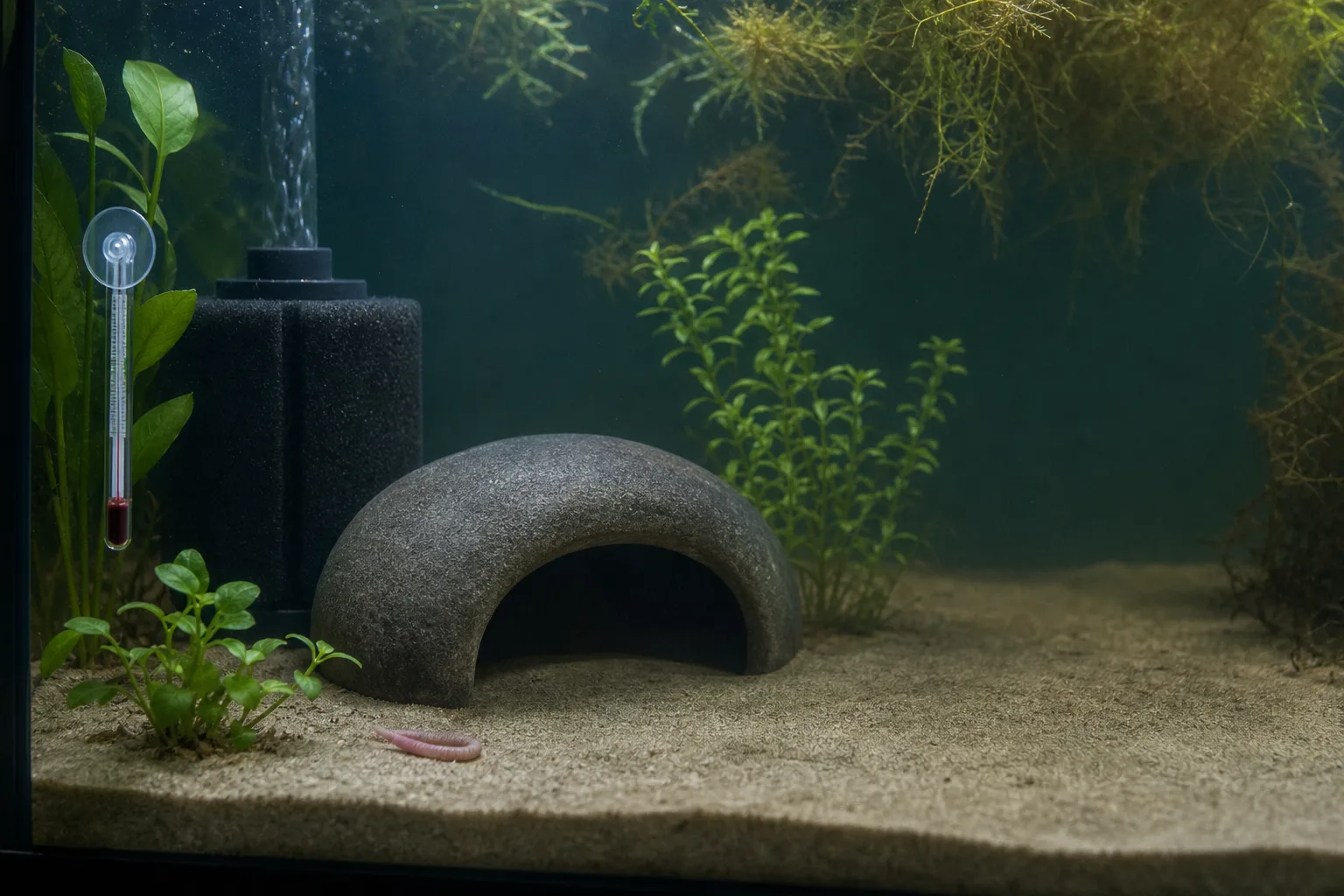
Axolotls need places to retreat. Bright light should be restrained and paired with shaded cover.
Filtration should support the nitrogen cycle without blasting the animal around the tank.
Read more →A tank is not ready because it looks finished. It is ready when the equipment, water tests and maintenance routine can protect the animal.
First
The filter must process a normal waste load before the axolotl arrives. Ammonia and nitrite should not be detectable in the stocked tank.
Daily reality
Room temperature drives tank temperature. If the room runs warm, solve that with fans, air conditioning or a chiller before it becomes an emergency.
Maintenance
Leave space to siphon waste, remove uneaten food and access the filter. Hard-to-clean aquascapes usually become skipped maintenance.
Axolotls can swallow substrate while feeding. If a piece is small enough to fit in the mouth but too large to pass safely, it is a risk.
Decor should not scrape skin or trap an axolotl. Check hides, caves and ornaments with the animal's adult size in mind.
A filter can be biologically useful and still physically stressful. Use gentle flow and watch posture, gills and resting behaviour.
Fish, snails and other animals can create injury, parasite, choking or water-quality risks. A species-only setup is the safer beginner path.
Safer path
Risky shortcut